
A menu built for the guest deciding in ninety seconds
A menu that lists everything the kitchen is proud of is built for the owner. One that gets a guest to a decision before the waiter comes back, while carrying the allergen information the Food Information Regulations 2014 require, is built for the table.
See the menu and allergen guidesA menu is read in an order, whether it's designed for one or not
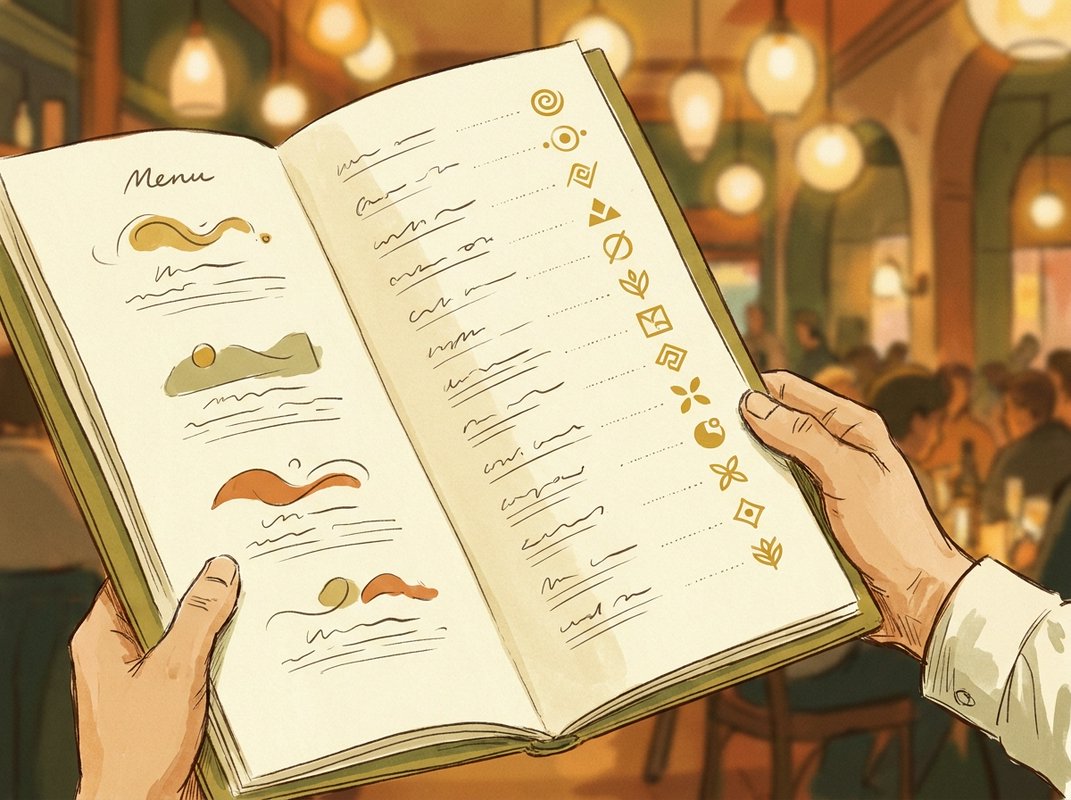
A menu gets designed in the order a guest actually reads it. That sounds obvious until you look at how many menus are laid out to please the person who wrote them.
Reading order
Most guests read the top of a page and the top of each column first, then scan down and across. We place the dishes a venue most wants ordered in those positions.
Description length
A description earns its place by helping a guest decide in the few seconds they actually spend on it. Two or three specific words, the ingredient that isn't obvious or the method that changes the dish, do more work than a full sentence of adjectives, and they're faster to update when a supplier changes.
Allergen information
The Food Information Regulations 2014, enforced by local authority environmental health, require a venue to be able to tell a guest which of the fourteen regulated allergens are present in any dish it serves. We build that into the menu itself as a clear reference system, an allergen matrix set out against every dish. What a venue must display, and in what form, is confirmed with the local authority or the Food Standards Agency before the design is fixed; see Menus That Sell and Menus That Comply for how the two requirements sit together on one page.
Print, screen or QR
- Print: fixed until reprinted, and it photographs well on a table, so it suits a menu that barely moves.
- Screen or website menu: correctable the moment a dish sells out or a price changes, no reprint needed.
- QR code: only as good as what it opens. A code pointing to a phone-sized page works; one pointing to a PDF of the print menu, shrunk and requiring a pinch to read, loses a guest faster than no menu at all.
None of the three is the right answer by default. The right one depends on how often the menu changes and where it gets read, at the table, at the bar, or before the guest has left home.
Keeping it current
A menu that moves with the season or the market shouldn't need a reprint every time it does. We separate what changes often, the dishes and the prices, from what doesn't, the layout and the identity, so a seasonal update is a text change.
What compliance looks like on a menu
A menu carries legal weight as well as sales copy. This is what to check before it goes to print or online.
-
Every dish is checked against the fourteen regulated allergens
The Food Information Regulations 2014, enforced by local authority environmental health, require you to state which of the fourteen listed allergens appear in each dish, whether it's on a printed menu, a chalkboard or a QR menu.
-
Prepacked for direct sale (PPDS) items carry a full label
Sandwiches, salads or boxed food made on-site and sold prepacked need a label showing the food's name and a full ingredients list with allergens emphasised, under Natasha's Law (Food Information (Amendment) (England) Regulations 2021).
-
Calorie information is added where the threshold applies
The Calorie Labelling (Out of Home Sector) (England) Regulations 2021 apply to businesses with 250 or more employees. Check with your local authority whether your venue's structure falls within scope before deciding what the menu shows.
-
An allergen matrix exists behind the menu
A table setting every dish against all fourteen allergens gives kitchen and front-of-house a single reference to check before a guest orders, and it's the document a menu redesign should update first.
-
The menu is checked against current guidance before it's printed
Thresholds and requirements are reviewed periodically. Verify what currently applies with the Food Standards Agency or your local authority environmental health team before committing to a print run.
This states what the regulations require of a menu; it isn't legal advice. Confirm current thresholds and requirements with the Food Standards Agency or your local authority environmental health team before you rely on any of it.
A menu that helps a guest decide is worth building properly
Reading order, allergen information and a file that can be updated without a reprint all sit in the same job. Our guides cover the detail; we can also do the work.